Jun 17, 2012

Denai´na birch bows and shooting techniques

1. Denai´na bow in action.
I recently tried out one of my birch Denai'na bows.The unbacked birch bow was 35pounds at a 25inch draw 158cm long. The bow had taken some set in earlier trials which gave it a 3 inch string follow. In retrospect this could have probably been avoided with a more prolonged heat-tempering of the belly. The birch had been too fresh to begin with and my initial heat-tempering was probably inefficient as moisture in the tree vaporized from the belly and acted as an cooling agent during the tempering process.

2. The bow and arrow set before adding the cable. The arrow is a copy of a Denai'na arrow in the Furuhjelm collection.

Most Denai´na bows in museum collections do not have any string follow so that means that I must be doing something wrong. Also the quality of the living birch tree might have a role in the performance of the bow.

3. The Denaína bow Vk202 in the Museum of Culture in Helsinki.

I have used Finnish birch (Petula pendula) for my bows. The Denai´na used, or prefered to use "Black Birch" which essentially is Alaskan birch (Betula neoalaskana). Possibly the Alaskan Birch has better bow qualities than the Finnish birch.Compression-failure is a real problem in these bows and heavy birch bows are more likely to fail in this way. This is one reason for the excessive wrapping on Dena'ina cable bows which cover most of the bow limbs.
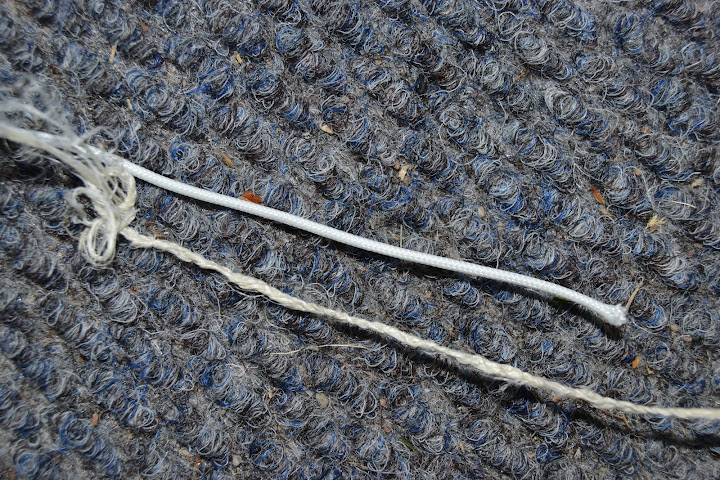
4. Real braided sinew and fake sinew.
I added a artificial sinew cable to the bow to find out what effect it had. As I did not have any ready sinew cord I had to resort to an synthetic option. I chose to use 3mm braided blind nylon cord which I bought in a local fishing tackle store at 0.3€ per meter. I added two loops from nock to nock and proceeded to add more cable to the bow approx one handwith from the knocks, spacing ten hitches towards the center of the bow approx. one finger width apart. In total I had as many as 28 strands laying flat on the back in the center section of the bow. I then wrapped up the bow with what was left of the string. In all I used up 50 meters of nylon cord to back this one bow.
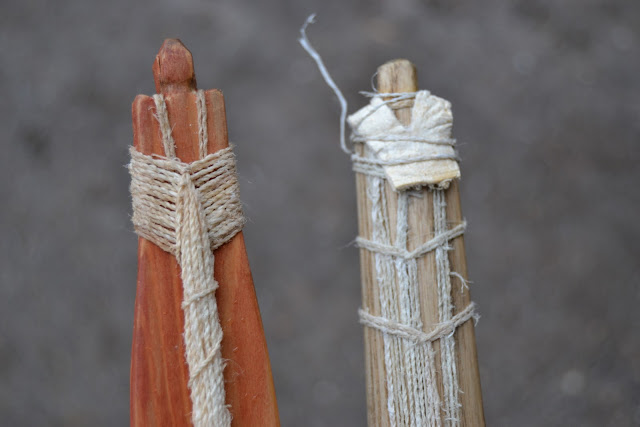
5. Compare the two - the upper Denai'na bow has fake sinew, the lower Katmai bow has real sinew.
This added 5 pounds to the draw but I also felt that the bow was "stacking" towards the end of the draw. Perhaps due to the fact that nylon does not have the same strechting qualities as sinew. Braided nylon does stretch a little but it is also has a more slippery feeling to it than real sinew. The latter grips the wood better than the nylon which tends to slip off more easily. To summerize I feelt that nylon should only be used as a temporary solution until real sinew line is produced.

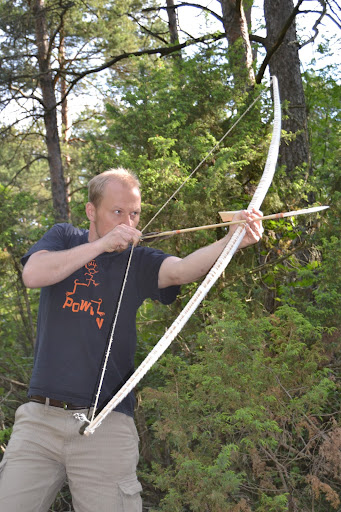
6.Athapascan draw, the arrow should be laying on the middle finger.
Using the bow is an interesting experience as the peculiar Athabaskan archery technique. The arrow is drawn with the right hand but the arrow is placed on the right side of the bow and the arrow is laying on the bow between the left hand fingers of the archer between the index and middle finger or the middle finger and the ring finger. When drawing the bow the arrow is pulled towards the archers right eye and the bow is tilted to the left.The bow guard is above the thumb of the archer.

The arrow also reacts to this type of shooting technique by being prone to excessive "jumping", that is the arrow spine has to be flexible enough to enable this type of shooting technique. I have to explore this issue further before making more assumptions on this matter. My goal is to get the bows up to 50 - 55 pound draw weight which would be a realistic weight for larger game animals such as caribou.

Photo credits 1,2,4,5,6. Marcus Lepola. 3. Martti Kujansuu

Apr 1, 2012

Alutiiq bows

I have recently been working intensively with Alutiiq bows and archery tackle. I have so far made two replicas of  the TAV13 Aluutiq bow in the Furuhjelm collection. I have also made a replica of a painted bow, the original was collected by Hermann von Friederici from Kodiak between 1803-1806 and is in the collections of the Ajaloo Museum in Tallinn, Estonia. These apparently different types of bows have been attributed to the Alutiiq, and in some cases, Russian scholars have claimed that the painted bows are of Unangan (Aleut) origin. 

1. Detail on the original bow collected by von Friederici in the Ajaloo museum. 
These bows represent two different types. The larger painted bow, which can be referred as the "Katmai"  type, requires more carving than the Alutiiq bow which is rounded and has less surface-area than the first type.

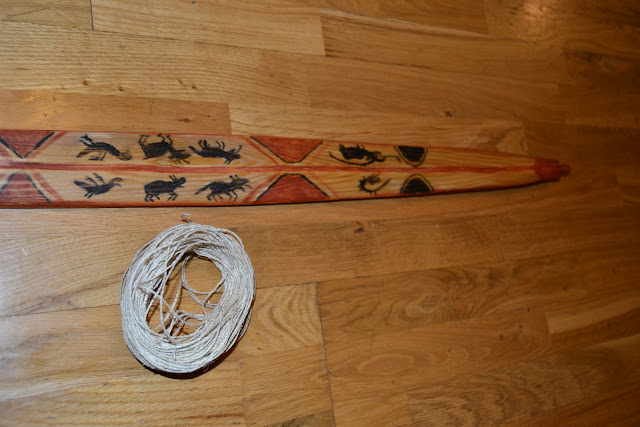
2. The replica and 30 meters of twisted sinew string.
The original Ajaloo bow is 146cm in long, the replica is slightly longer, it measures 150 cm. The replica is made out of larch, which is the only native hardwood in Alaska. The cable backing is made up by 30 meters of twined sinew string which goes from one end to the other.


3. The TAV13 bow and the Douglas Pine replica.
The TAV13 bow was collected in the late 1850s by Hjalmar Furuhjelm. The bow originated from Nutchek village in Prince William Sound. The replicas are made of Douglas Pine and Ash. Ash was however never used as a bow wood by Alutiiq but I decided to make a compromise in order to have a practical test version of the bow. 

Both replicas and the original bow are 132 cm long. The backing is made up by 16 strands of plaited sinew, about 20 meters in all.  Moose leg-sinews have been used to make the cables on all three replicas

4. Both bows strung,

The design of the bows is very different, however both bows store a chocking amount of energy. The Alutiiq bow stacks quickly and reaches 60 pounds at a 24 inch draw. The Katmai bow is very stiff and I have been careful not to strain the limbs to much before the wood has had time to set. Currently the bow exceeds the 60 pound marker at 20 inches and it has not yet been drawn beyond that point.
5. Handle sections.
This process has yielded much new information about the Alutiiq bow making process and these discoveries will be in detail discussed in the ”Alutiiq bowery” - article I plan to publish in 2013.

6. Side by side view of the bow bellies.

I still have to make some plaited sinew string for these three replicas before they can be considered as ready.

7. Detail of the sinew binding at the ends of the bows.

Links:

Sources:

Beyond Bering. The Russian Colonies in the North Pacific 1741-1867. From the Estonian History Museum in collaboration with the Staatliches Museum für Volkerkunde Munich.
Jean-Loup Rousselot, Veronica Grahammer. Fondazione Galleria Gottardo 2004, 263 pp, ill [In Italian, Germany and English]

Photo credits:
1-7 Marcus Lepola 2012.


Mar 13, 2012

Replicating Eskimo Bow Technology – Is close enough good enough?

The Eskimo inhabit a wast range of the northern hemisphere. The arctic environment and the limited availability of natural resources influenced the material culture of the Eskimo. The kayak is a good example of how local availability of material for construction, together with the special functions of the kayak influenced the design of the craft. The same rules also apply to the bow and arrow.

The bow is not an "stand alone item" in the toolkit of the Eskimo, it is a narration of the environment and the particular culture from which it emerged. As anthropologists we have to be very conscientious about how we treat and present this narrative. It is our obligation not to disturb or change the narrative as it will only result in a dilution of the traditions we are trying to salvage.

As I have been preparing for my coming ”Alutiiq bowyery” trip to Alaska next summer, I have also been looking at number of written sources on Eskimo bow replication. There are not that many of them, but the name Errett Callahan keeps popping up in my browser. Dr. Errett Callahan is an renowned anthropologist/primitive technology specialist. In the late 1980s he was engaged in a project to teach the Inuit of Belcher Island traditional skills such as arctic bow making. Callahan's assignment was to recreate a bow similar to what had been used during the heyday of Arctic bow hunting and to later use the recreated bow in a actual caribou hunt. The project was published in three different articles in Primitive Technology II, Ancestral Skills 2001.
The bow Callahan replicated, a bow from Bristol Bay (plate 2 Murdoc).

As such the project is interesting and the finished bow along with detailed sketches produced a lot of practical information on Eskimo bow-technology. But there are also some issues with this project which need to be discussed in retrospect. Even if the project involved Canadian Inuit, Callahan focused on western Eskimo bows due to reasons of practicality, and thus ignoring the East Arctic bows all together. In his article he admits to cutting corners and in order to make a bow type he felt more comfortable re-producing, in this case a Yup´ík bow from Bristol Bay.

Is this a big deal? Yes, in my opinion, since going about projects in this careless manner is a distortion of bow making traditions that the anthropologist is trying to preserve in an given area. The bow Callahan replicated really has no similarities to bows in the Baffin Island area. The cable backing technique reproduced by Callahan is of the Southern Type (Murdoc 1890). This type of backing is different from the Arctic Type (Murdoc 1890) used in the East Arctic. Bows from this area were typically made out of antler which means that they had to be put together of several different pieces. The bow that Callahan reproduced was originally made out of one piece of spruce or larch (not ash). The Yup´ik of Alaska had better access to driftwood than the Inuit of the central Canadian Arctic and could more easily recover suitable material for bows. Driftwood was scarce in the Baffin Island area and this fact posed a large problem for the Inuit bowyers. If wood was ever found these pieces were often brittle and of poor quality, so antler was commonly employed for bow-building. The Southern Type backing is not suited for making several piece bows. However the more elaborate Arctic type backing is perfectly adapted for piecing together bows from several pieces.
This is how bows from the Baffin Island area look like. (fig 1, Birket-Smith 1918)

Any anthropologist researching and sharing knowledge on traditional skills should be mindful to the original narrative of the cultural area he is working with. This approach provides real possibilities for native elders and young people to interact with their environment in the same way as their ancestors did. Buying wood such as ash for bows from the local lumber store is only a half-way marker, it´s a good start but it should not be the ultimate goal. The risk is also that people are willing to settle for a ”lesser” version because the ”real-deal” is so much more difficult to make and probably performs less well than a top-of-the-line lumberyard bow.

A lot of hidden knowledge is being overlooked this way and perhaps even lost when choosing not to make the extra effort and going all the way with challenging reconstructions.
Cook Inlet sea-otter arrow, this type of arrows where only used for marine hunting.Mason 1894, plate LIX.

Another issue that I think is a bit problematic with the Callahan project was the two sets of arrows that he made to go along with the Yup'ík bow. One of these sets are replicas of Cook inlet arrows intended for caribou hunting. Callahan has been inspired by the sea-otter arrows from Cook inlet area and presents his own versions of these as replicas. These are in fact not replicas at all as these type of arrows which Callahan ”replicated” with obsidian points do not exist in any museum collections. This type of arrows with rounded bulbous nocks and high fletching were exclusively used for hunting sea otters or water foul from kayaks. The arrows used for land mammal hunting in the same Cook inlet area are of a entirely different type. In this case Callahan should have made it clear that these arrows are a distortion of the original and have no real scientific value as such.

It is important to be clear on when a project is more about "primitivist" experimentation than the reproduction of real ethnographic artifacts.  


Alutiiq bow in the Furuhjelm collection and the replica. Photo Marcus Lepola.

Further reading:

Birket-Smith, Kaj 1918. The Greenland bow. Meddelelser om Grönland p 1-28. Bianco Lunds bogtryggeri, Köpenhavn.

Callahan, Errett 2001. Archery in the Arctic 1-3. Primitive Technology II – Ancestral Skills, p. 119-133. From the Society of Primitive Technology, ed. David Westcott. Gibbs & Smith Publisher, Salt Lake City.

Mason, Otis Tufton 1894. North American Bows, Arrows and Quivers. The Smithsonian Report for 1893, pages 631-679. Government Printing Office, Washington.

Murdoc, John 1890. A study of the Eskimo bows in the U.S. National Museum.From the Report of the Smithsonian Institution 1883-84 part II, pages 307-316, I-XII. Government Printing Office, Washington.  
Nov 22, 2011

Alaskan eskimo bows

As I have been busy with work and research I have been unable to update my blog for a while. I have been involved in the intensive study of a small collection of native artifacts from Alaska. This collection is previously unknown and the catalog as well as the result of the study will appear in print at some time, hopefully as early as in 2012.

This collection also includes a number of bows and arrows. I have been able to carefully study these artefacts in great detail and as such learned some new and interesting facts about native Alaskan bowyery. This study also includes making a few working replicas of the bows and arrows as it is also very important to learn how exactly these bows were made and used.

There have been a number of studies made on Eskimo bowyery, some scholars have even made actual replicas of eskimo-bows. Very few, if any of these have used the same inferior softwoods as the original eskimo bowyers, often substituting Black Spruce, Douglas Fir and Tamarack with less tempered woods such as Ash and Yew. Although Yew has been used for bow-manufacture in southwestern Alaska, many bows have also been made using more inferior species of wood.

Original and replica of a Southwest-Alaskan bow.
The challenge is to make working replicas of these Alaskan bows using the same inferior bow woods as the original bowyers used and in the process perhaps rediscover the craft and skills of the Alaskan bowyers.

Mar 28, 2011

AMNH Object: TRAP, MOUSE [ 1 / 4889]

I just made an interesting discovery while browing throught the online collections of the American Museum of Natural History. I was looking for an interesting Tlingit-mousetrap I found a sketch of in Emmons & De Laguna; The Tlingit Indians. The trap illustrated in the book was identical to the Finnish mousetrap in my blog. I happened to stumble across the exact same trap among the Ojibwa? As the trap is from the Midwest, chanses are some Finnish immigrants introduced the model to local Native Americans.
This is a very interesting discovery since it suggests that Finns and Native Americans exchange traditional knowledge among each other in two different locations on the North American continent.  I will research this issue further as soon as possible. Compare this to the one I posted earlier; Northern Wilderness Skills and Traditions: Old Finnish Mouse Traps:


AMNH Object: TRAP, MOUSE [ 1 / 4889]

Mar 6, 2011

Siberian Hanti skis part 2

As the skis were done the next step was to proceed with the bindings. The bindings on the model skis were interesting, In most Siberian skis the binding is made out of leather thong, but in this case a loop made out of a twig or a brach is jammed in to the two holes on the opposite sides at the "päläs".

Image 1. Two different types of bindings for a flat "päläs".
The ski has to be balanced correctly, which in this case means that the rear has to be slightly heavier that the front of the ski. I drilled the holes at the mid-section of the ski, balance has to be adjusted by removing wood until both skis are identically balanced. 

Image 2. A fresh juniper branch is driven through the holes in the ski-board

 .
 

In order for the stick/twig loop to hold two things have to be taken in to account: 1. The holes have to be drilled in an angle away from each other so that the loop will hinge correctly. 2. The stick/twig has to be inserted when it is fresh or when it has been heated and left to dry for a day or two before it is jammed in and trimmed.

Image 3. The finished skis.
 
As the loops had dried and been fitted I added the bindings, two strips of brain-tanned moose hide. I also rubbed the skis with seal oil. The finished skis weighted 1,5kg a piece. Their measurements; max. thickness 1.8 cm., lenght 160 cm and max. width 16.3cm.

Image 4. The Hanti skis to the left.
Photo / Image Credits
Image 1 Istoriko-etnograficeski atlas Sibiri 1966.  
Image 2-4 Marcus Lepola

Mar 2, 2011

Siberian Hanti skis part 1

This winter has been extreme, cold Siberian and Arctic winds have been blowing across Finland and partly because of this I have been inspired to explore the ways of our language-relatives in Russia.

I have been planning to make a pair of snowshoes but I realized that I could instead replicate the next best thing;  - a simple pair of Siberian skis. The Siberian skis represent a very archaic form of skis. The Siberian ski-type is spread across a wide territory from the Western slopes of the Ural mountains to the Kamtchatkan Peninsula in the East. The ski-type and is very distinct as it it shorter and broader than skies used in the Nordic countries. Skis of this type have a very flat, boardlike appearance.

These type of skis are made to enable winter-travel in the thick powdery snow of the Siberian taiga. These skies are more for walking than for gliding. They are in fact more like snowshoes than skis. 

Even if the Siberian skies appear very similar at first glance there are many differences in construction among the Siberian peoples. There are variations in the shape of the ski and the width-lengt proportions. There are also differences in how the footing surface on the skis are constructed, in Finnish this part of the ski is called päläs and there are three different type of päläs. The footing or päläs can be flat, raised or it can be formed as an channel for the foot. 

Image 1. From the left; a Hanti ski with a raised päläs, a Komi ski with a channel päläs and a Hanti ski with a flat päläs.

The Siberian skis are often fitted with fur on the bottom of the ski. The skin is attached on the running surface of the ski so that the hair points backwards. The most typically used skin was the legskin of reindeer as the skin is though and the short hairs provide traction when climbing hills but glide effortlessly forward. Sealskin was also used by coastal dwellers. 

It is interesting to note that the same type of short broad skis were used in Finland and Scandinavia during the neolithic and the bronze-age. There are several finds of skis in bogs and these resemble the Siberian types. 

Image 2. The Kalvträsk skis and ski-staff.

There is also some drama in connection to the prehistoric skis found in the Nordic bogs as there is some debate conserning which country can claim to own the oldest ski in the world. Three men digging a ditch in a bog near Kalvträsk in Västerbotten, Sweden in 1924 discovered two 15cm wide and 204 cm long skis along with a skipole. Later C-14 dating of this find confirmed the age to 5200 BP (before 1950). In Northern Finland, some 10 km from Saija, Jaska Repo, a farmer diggin a ditch in a bog called Särkiaapa in 1938 unearthed a broken ski. The ski is estimated to have been 15cm wide and max. 180 cm long. The ski from Särkiaapa was also C-14 dated to 5200 BP. So both findings date back to 3200 B.C. Sadly for the Finns a second c-14 dating of the Särkiaapa ski resulted in 4470 +/- 110 BP, so it appears that the Swedes won this time!
Image 3. The Särkiaapa ski from Salla, Finland.

Although inspired by all this I was in a hurry to finish a serviceable pair of skis in matter of only a week so I decided against making a copy of some archeological find and to go for a fairly simple model with a flat päläs-design to reduce carving-time. 
Image 4. A pair of hanti skis design for use on crusted snow.

I found a photo of a Hanti ski that seemed easy enough to make. I pretty much had to guess the lenght of the ski since the book in which the ski was sketched did not provide any exact measurements. This type of ski should perform best in spring when the sun melts the surface of the snow and it freezes to a crust during cold nights. This would suit me perfectly as it is already March and winter will only last for a few more weeks in southern Finland. 
Image 5. One ski is cut out from the spruce board.

I picked up some wide spruce boards at the local lumberyard (thanks Edgar!). The wood was not perfect as there were several knots in the boards. I managed to carve the skis so that there is a knot in the middle of the tip on both skis. This should prevent the tip from cracking as spruce is prone to crack easily.
Image 6. Bending the steamed tip.
The bottom, or the running side of the ski was carved flat and the top convex. I slightly stream-bent the tips after first soaking them in water for a couple of days. The skis are now almost finished, I still have to fit them with some bindings and also apply some animal fat on the wood before I can try them out.

Image 7. The small crack in the tips have not advanced beyond the knothole.

Photo / Image Credits
Image 1. Suksen tarina, Eino Nikkilä 1966.
Image 2. The Museum of Västerbotten
Image 3. National Board of Antiquities, Finland.
Image 5-7 Marcus Lepola.


Further readings

"Själen" – Seal Hunting in the Northern Baltic Sea

Foreword The following post is intended as a more academic source of information on traditional sealing in Finland and the Northern Baltic...