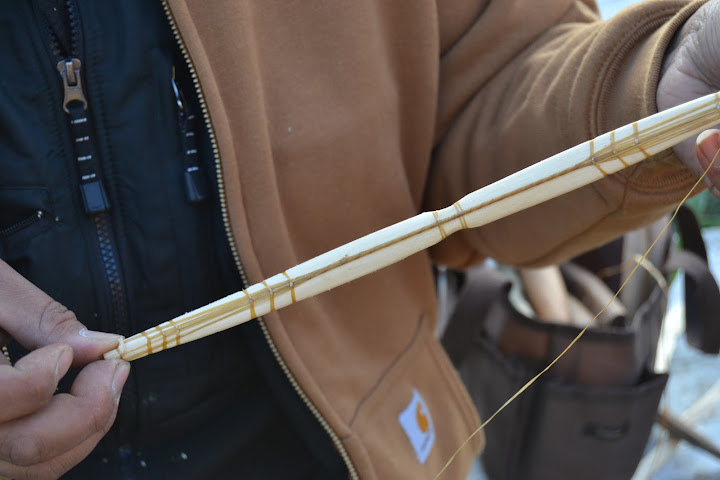
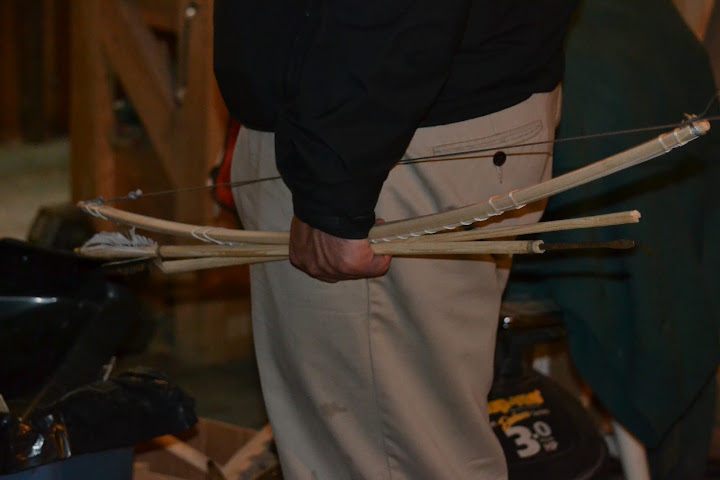
The Eskimo inhabit a wast range of the northern hemisphere. The arctic environment and the limited availability of natural resources influenced the material culture of the Eskimo. The kayak is a good example of how local availability of material for construction, together with the special functions of the kayak influenced the design of the craft. The same rules also apply to the bow and arrow.
The bow is not an "stand alone item" in the toolkit of the Eskimo, it is a narration of the environment and the particular culture from which it emerged. As anthropologists we have to be very conscientious about how we treat and present this narrative. It is our obligation not to disturb or change the narrative as it will only result in a dilution of the traditions we are trying to salvage.
As I have been preparing for my coming ”Alutiiq bowyery” trip to Alaska next summer, I have also been looking at number of written sources on Eskimo bow replication. There are not that many of them, but the name Errett Callahan keeps popping up in my browser. Dr. Errett Callahan is an renowned anthropologist/primitive technology specialist. In the late 1980s he was engaged in a project to teach the Inuit of Belcher Island traditional skills such as arctic bow making. Callahan's assignment was to recreate a bow similar to what had been used during the heyday of Arctic bow hunting and to later use the recreated bow in a actual caribou hunt. The project was published in three different articles in Primitive Technology II, Ancestral Skills 2001.
 |
The bow Callahan replicated, a bow from Bristol Bay (plate 2 Murdoc).
|
As such the project is interesting and the finished bow along with detailed sketches produced a lot of practical information on Eskimo bow-technology. But there are also some issues with this project which need to be discussed in retrospect. Even if the project involved Canadian Inuit, Callahan focused on western Eskimo bows due to reasons of practicality, and thus ignoring the East Arctic bows all together. In his article he admits to cutting corners and in order to make a bow type he felt more comfortable re-producing, in this case a Yup´ík bow from Bristol Bay.
Is this a big deal? Yes, in my opinion, since going about projects in this careless manner is a distortion of bow making traditions that the anthropologist is trying to preserve in an given area. The bow Callahan replicated really has no similarities to bows in the Baffin Island area. The cable backing technique reproduced by Callahan is of the Southern Type (Murdoc 1890). This type of backing is different from the Arctic Type (Murdoc 1890) used in the East Arctic. Bows from this area were typically made out of antler which means that they had to be put together of several different pieces. The bow that Callahan reproduced was originally made out of one piece of spruce or larch (not ash). The Yup´ik of Alaska had better access to driftwood than the Inuit of the central Canadian Arctic and could more easily recover suitable material for bows. Driftwood was scarce in the Baffin Island area and this fact posed a large problem for the Inuit bowyers. If wood was ever found these pieces were often brittle and of poor quality, so antler was commonly employed for bow-building. The Southern Type backing is not suited for making several piece bows. However the more elaborate Arctic type backing is perfectly adapted for piecing together bows from several pieces.
 |
This is how bows from the Baffin Island area look like. (fig 1, Birket-Smith 1918)
|
Any anthropologist researching and sharing knowledge on traditional skills should be mindful to the original narrative of the cultural area he is working with. This approach provides real possibilities for native elders and young people to interact with their environment in the same way as their ancestors did. Buying wood such as ash for bows from the local lumber store is only a half-way marker, it´s a good start but it should not be the ultimate goal. The risk is also that people are willing to settle for a ”lesser” version because the ”real-deal” is so much more difficult to make and probably performs less well than a top-of-the-line lumberyard bow.
A lot of hidden knowledge is being overlooked this way and perhaps even lost when choosing not to make the extra effort and going all the way with challenging reconstructions.
 |
| Cook Inlet sea-otter arrow, this type of arrows where only used for marine hunting.Mason 1894, plate LIX. |
Another issue that I think is a bit problematic with the Callahan project was the two sets of arrows that he made to go along with the Yup'ík bow. One of these sets are replicas of Cook inlet arrows intended for caribou hunting. Callahan has been inspired by the sea-otter arrows from Cook inlet area and presents his own versions of these as replicas. These are in fact not replicas at all as these type of arrows which Callahan ”replicated” with obsidian points do not exist in any museum collections. This type of arrows with rounded bulbous nocks and high fletching were exclusively used for hunting sea otters or water foul from kayaks. The arrows used for land mammal hunting in the same Cook inlet area are of a entirely different type. In this case Callahan should have made it clear that these arrows are a distortion of the original and have no real scientific value as such.
It is important to be clear on when a project is more about "primitivist" experimentation than the reproduction of real ethnographic artifacts.
 |
| Alutiiq bow in the Furuhjelm collection and the replica. Photo Marcus Lepola. |
Further reading:
Birket-Smith, Kaj 1918. The Greenland bow. Meddelelser om Grönland p 1-28. Bianco Lunds bogtryggeri, Köpenhavn.
Callahan, Errett 2001. Archery in the Arctic 1-3. Primitive Technology II – Ancestral Skills, p. 119-133. From the Society of Primitive Technology, ed. David Westcott. Gibbs & Smith Publisher, Salt Lake City.
Mason, Otis Tufton 1894. North American Bows, Arrows and Quivers. The Smithsonian Report for 1893, pages 631-679. Government Printing Office, Washington.
Murdoc, John 1890. A study of the Eskimo bows in the U.S. National Museum.From the Report of the Smithsonian Institution 1883-84 part II, pages 307-316, I-XII. Government Printing Office, Washington.